At a Glance
If you are arranging hotel massage for two near Toronto Pearson, ask whether the provider can schedule two individual sessions in the same room, one after the other. Confirm the total time the room will be in use, what each guest is booking, and what happens if one person arrives late. Check the hotel's visitor policy and room setup before either guest commits.
Hotel Massage for Two Near Pearson: How to Plan Separate Sessions in One Room
Only have 30 seconds?
- Ask for two individual start and finish times, including any break to reset the room.
- Confirm what each guest is paying and how a change to one appointment affects the other.
- Check where the guest who is waiting will spend that time and whether the room is suitable for setup.
- Start with the Airport Spa home page for the site's Pearson-area service information.
Why the words “for two” need a follow-up
Two people travelling together may want massage on the same evening, but they can mean different things when they make the request. One may expect two professionals to arrive together, while the other pictured one professional seeing each guest separately. A booking conversation that starts with the number of guests and the format you want can clear up that difference. If you are interested in consecutive appointments, use that wording and ask whether the provider can confirm both times.
A consecutive booking uses the room for one session at a time. Each guest can tell the provider what they are comfortable with, how long they want their session to last and whether there are areas they would prefer to avoid. The person making the booking can share the hotel details and reservation timing. The provider may still want to speak with each person separately about what they are agreeing to. Being travel companions does not make the two appointments interchangeable.
You might decide that only one person wants a session after hearing the choices. That is easier to handle before a reservation is made. If you have already booked both times, check which changes the provider allows and any deadline or fee. A simple question is, “If one of us can no longer attend, can the other keep their original time, and what would the bill be?” Ask the provider to confirm the answer in whatever written booking channel it normally uses.
What occupies time on either side of the massage
The total time the room is in use can include arrival, setup, a conversation with the first guest, that guest's session, a reset for the second guest, and packing up. Ask the provider what the quoted session duration includes. Some providers may describe hands-on time and setup separately. Others may quote the length of the appointment as a whole. Get both scheduled start times and the estimated time the room will be free again.
Here is an example for planning, with made-up times. Suppose the first guest wants a 45-minute session and the second wants 60 minutes. The combined session time is 105 minutes. If you have only a two-hour window, that leaves 15 minutes for everything else, assuming those lengths refer to hands-on time. Ask the provider how much time it expects to need for the whole booking. That answer tells you whether the window is realistic or whether you need to request different times or lengths.
Decide in advance whether either guest has a hard stop. One may need to take a work call. The other may have to meet a shuttle or go downstairs to collect food. Tell the provider which person has the fixed commitment and ask how it would affect the order. If timing is tight, ask about booking only the session that fits comfortably. Make any change before the agreed cutoff. A plan that depends on setup, access and transitions all happening instantly has very little room for ordinary delays.
Plan who uses the room between sessions
Ask the provider what floor space and access it needs. A photo of the room layout without guests, documents or identifying details can help the provider assess whether there is room for its equipment. Ask about the floor area beside the bed, the path between the door and setup area, and any furniture that ought to stay where it is. If the only clear corner is where both travellers have opened their cases, build time into your plan to repack and move the luggage out of the walking route.
The guest who is waiting should have a place to be. That might be another room, a lobby seating area if the hotel permits it, or a nearby place both guests know how to reach. Discuss privacy first. Some people are comfortable with a companion nearby. Others prefer the room to themselves while speaking with the provider or during the session. Let each guest make that choice and confirm the arrangement with the provider so the transition between appointments is predictable.
Room keys can be overlooked when both people are used to coming and going together. Check how the waiting guest will regain access at the agreed time and how the provider will be admitted under the hotel's process. Share access details only with the people who need them, through the method the hotel and provider agree on. If someone will be away from their phone, agree on a meeting spot or a time to check messages.
How to keep the two appointments separate
Make one list for the hotel logistics and a separate line for each guest's appointment. The shared details are the hotel name, street address, the approved arrival or check-in process, and the booking contact. The individual details are each guest's name, preferred appointment duration, start time and whether any change to that appointment has been confirmed. Each person can discuss individual preferences directly with the provider.
If guests want different styles of massage, ask what can be offered within one visit before setting times. The provider may need to know whether both requests can be handled by the same person, whether equipment requirements differ and whether more setup time will be needed. A booking for two consecutive sessions works only if the provider confirms the arrangement. Ask which parts can be changed on the day and which depend on how the provider staffed and timed the visit.
Use the same approach for payment. Ask whether you will receive one total or two separate charges and whether any travel or other fees apply. If the provider quotes one total, ask how it is calculated and what happens if one session changes. If one guest wants their own receipt, check what information the provider can include and how it will issue it. Keep the focus on the amount and booking terms the provider actually confirms for your visit.
Where to confirm the booking around Toronto Pearson
Airport hotel names can sound alike, particularly along the Airport Road, Dixon Road and Carlingview Drive corridors. Start with the full address on your hotel confirmation. A property near Viscount Road on the Mississauga side may have a different access route from one on Dixon Road in Etobicoke. Postal prefixes such as L4V and M9W can help you orient yourself, but use the complete address when speaking with the provider. If your hotel changes, confirm the new destination before treating it as covered by the old booking.
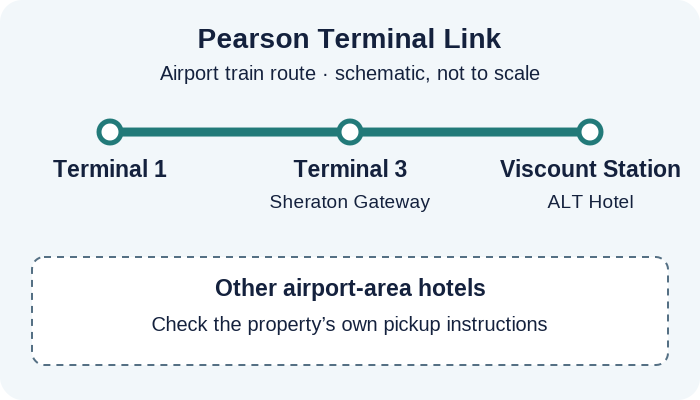
- Terminal and hotel connections. Pearson lists hotel shuttle pickup points on the arrivals levels at Terminals 1 and 3. Some properties can be reached by the Terminal Link train. Confirm the connection with the hotel and allow time to reach your room.
- Transit and walking. Check where your route stops and how you will travel from the stop to the hotel entrance. The practical walk can differ from the distance shown between two pins on a map.
- Driving and parking. If you are coming via Highway 427 or the 401, leave time for the local approach. Confirm the driveway and visitor parking instructions the property wants the provider to use.
- Accessibility. Check the accessible route from the entrance to the room, whether a lift is involved and whether equipment can pass through the room doorway. Ask about accessible transfer options separately if either guest needs them.
The airport-area map gives you a starting point for the conversation. Use the airport hotel massage guide for the site's broader information on guest-room bookings. Confirm the actual property's rules about visitors and any separate steps for reaching a guest floor. A policy at one hotel tells you little about the house rules at another, even when their entrances are only a short drive apart.
Decide what happens when one person is late
Travelling together can still mean arriving separately. One guest might check in first while the other returns a rental car. Before you book, identify which appointment can go ahead if only one person is present. The provider may be able to keep the originally confirmed order or may need both guests to stick to the agreed times. Ask before changing the order, even when both sessions are supposed to have the same length.
If travel is running behind, send the provider a clear message with the new estimate and the appointment it affects. For example, “The guest booked second is still at the terminal. The first guest is in the room and ready. Can you confirm which appointment can go ahead and the latest time the second guest must be there?” A message like that lets the provider respond to a specific situation. If the provider changes anything, confirm the new start time and any effect on the charge.
Also agree on when to stop waiting for a reply and make a different plan. If one guest has a flight-related commitment, that person can treat it as the fixed part of the evening. A change that would squeeze a session up against the hotel departure time may be impractical. Check the change terms while booking so either person can decide what to do without having to renegotiate every detail while carrying luggage through a terminal.
What a usable confirmation looks like
Before the appointment, read the confirmation together. Each guest should be able to point to their own start time, their session length and where they will be when the other guest is in the room. You should also know the total expected cost, what the provider needs for room access and when the room can return to ordinary use. If the confirmation lists one time beside two names, ask whether that time applies to both arrivals, to the first session, or to the provider's setup.
A short booking message might read, “Two registered guests at the same hotel, looking for consecutive individual sessions. Please confirm what room setup you need, the start and finish time for each person, the full cost and the rule if one guest is delayed.” Add the street address and your preferred window when you send the request. Keep the reply where both guests can find it. Once everyone can see the same plan, the only remaining decisions are the ones you and the provider make individually on the day.